Creative Survival: Reinventing a Seattle Bar During COVID and Beyond


When COVID threatened Gold Bar, the Seattle cocktail bar we had opened in 2018, closing up shop wasn't our only option. We had 6,500 square feet of vacant space, an art department full of production sets, and a street outside that wasn't seeing much traffic. We converted those assets into the Crown Social Distancing Club, worked with Seattle's Department of Transportation to create an expansive outdoor patio, and eventually turned the indoor space into Beyond Space, a venue for hundreds of events. One business. Several reinventions. And a fairly practical lesson in creative entrepreneurship.






When the room isn't big enough
In 2018, Crown Social Agency helped conceive, finance, design, and open Gold Bar in Seattle's South Lake Union neighborhood. Our office was directly behind the cocktail bar, in the same old Art Deco commercial building. It was an unusually convenient arrangement for an agency with a habit of bringing work home.
Gold Bar was profitable from its first year, and the room had become a gathering place for artists, musicians, neighbors, and the people working throughout South Lake Union. Then came COVID. Almost overnight, everything that made a cocktail bar work became a liability. Crowds. Close conversation. People sitting shoulder to shoulder. The casual intimacy of a good night out.
A six-foot distancing requirement made the original room impractical for the kind of business we'd created, and the obvious choices weren't especially appealing. We could wait. We could close. Or we could figure out how to make a completely different use of the resources we already had.
The Crown Social Distancing Club
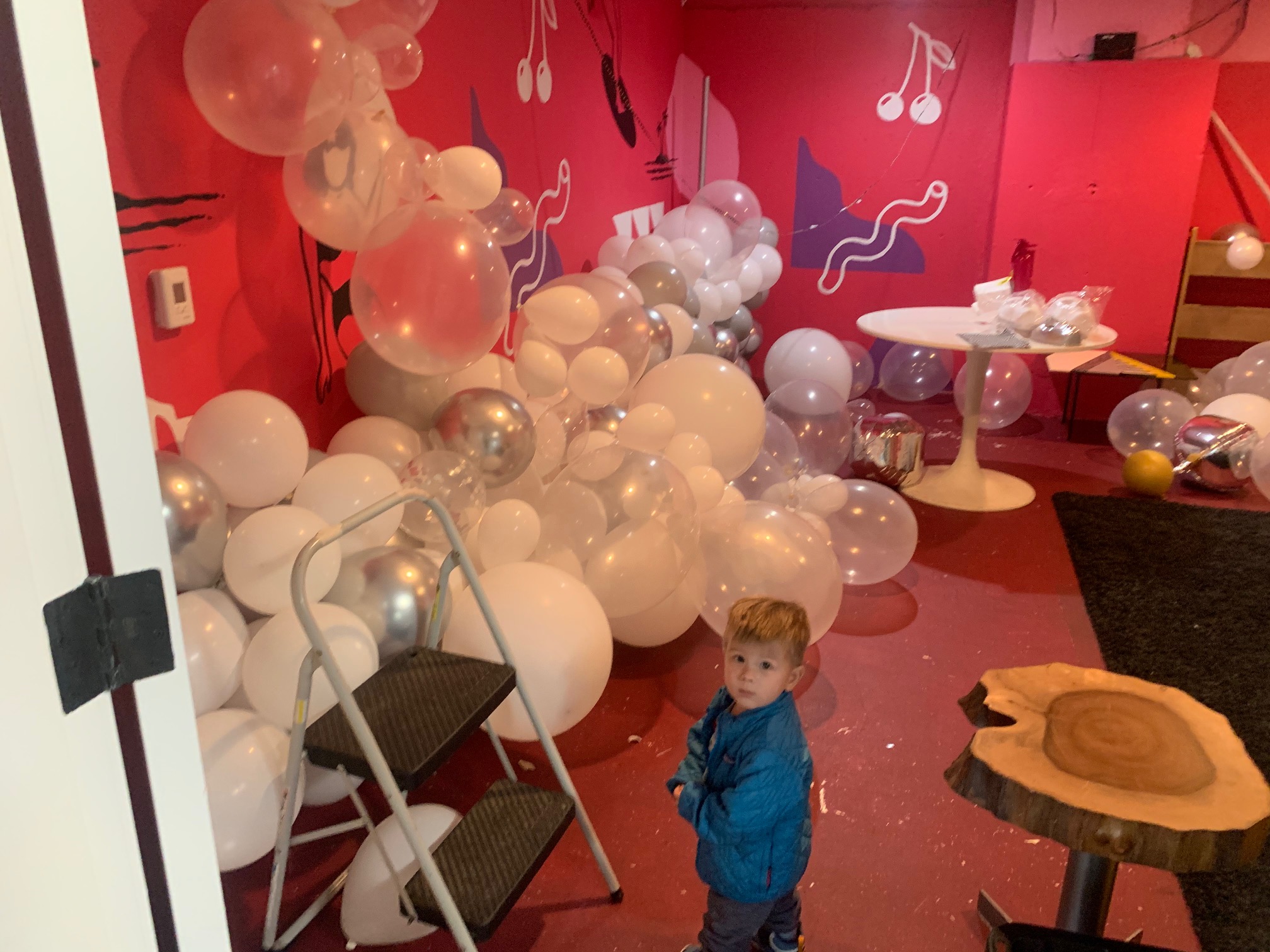
Behind Gold Bar sat roughly 6,500 square feet of vacant space. CROWN used the area for video shoots and livestream production. Our art department had constructed temporary sets, collected furniture, and accumulated props and scenic materials. Ordinarily, those things would eventually be packed away, reused on another production, or discarded. Instead, we looked at them as the beginnings of an entirely different room. What if the commercial sets became places for guests to sit?
We moved into the larger area and repurposed the materials into a series of individual lounge environments. Furniture, scenic backdrops, lighting, and props gave each area its own personality. Groups could gather in separate living-room-style settings with additional space around them. We called the new space the **Crown Social Distancing Club**.
The name was a joke. The problem was not. The additional square footage allowed Gold Bar to operate in a different configuration under the distancing requirements of the time. It also created an experience that probably never would have occurred to us under normal circumstances.
We weren't designing a conventional bar interior. We were recycling sets that had originally existed for a camera, turning temporary production scenery into a hospitality environment people could actually occupy.
The experiment attracted attention, including coverage of the new space in the media, and suddenly a constraint on gathering had given us a completely different way to gather.
Taking the party outside
While we were building the Distancing Club indoors, another possibility was sitting directly outside our front door: Ninth Avenue.
With much of South Lake Union working from home, the street was unusually quiet. Restaurants and bars across Seattle were looking for ways to serve people outdoors, and the Seattle Department of Transportation was introducing temporary street-use arrangements.
We worked with SDOT to close the block to ordinary vehicle traffic and help establish an outdoor hospitality area approximately 100 feet long.
The result was an expansive patio where guests could sit outdoors, have a drink, and hear music. DJs became part of the outdoor experience, providing something that was suddenly difficult to find elsewhere in the city.
There were still complications. Seattle weather remained Seattle weather, and wildfire smoke periodically made outdoor gathering impossible. But the street gave Gold Bar another operating mode, independent of the original interior and the newly expanded Distancing Club. An underused public thoroughfare temporarily became a place for neighborhood activity. For a business built around bringing people together, that was a pretty useful piece of real estate.
From temporary solution to Beyond Space
Eventually, the distancing restrictions lifted. But the expanded room remained. By then, the agency had become accustomed to working remotely, and the former office and production area had demonstrated that it could accommodate far more than commercial shoots or distanced cocktail service.
So we changed its purpose again. The Crown Social Distancing Club became **Beyond Space**. The living-room environments and flexible layout provided a starting point for a new public and private event venue. The programming expanded into live music, art, DJ performances, community gatherings, brand activations, and private events. Organizations including Google, Nordstrom, Amazon, Apple, Airbnb, Meta, Seattle Interactive Conference, Future Arts, and others were among our first event clients and collaborators.
Artists brought their audiences into the space. Businesses used the room for gatherings. Community organizations found a place for fundraising, celebrations, and creative programming. The flexible environment allowed us to adapt the room repeatedly without committing it to a single kind of event. Beyond Space ultimately hosted hundreds of public and private events.
A space for more than business
The venue also became a place to organize gatherings in support of charitable causes.
Gold Bar and Beyond Space hosted or supported fundraising activities benefiting organizations including The Vera Project, Lavender Rights Project, Mary's Place, Lifelong, and others.
The value of having another idea
None of this was part of the original business plan.
We opened Gold Bar to run a cocktail bar, not to build a socially distanced lounge from leftover commercial sets or negotiate the temporary closure of a city street.
The changes required financial decisions, physical work, creative production, government coordination, and the ordinary operational headaches that come with running a hospitality business. Some adaptations were temporary. Others developed into entirely new uses for the space.
Creative thinking didn't eliminate the difficulties facing the business. But it gave us more options for responding to them. And, in the process, helped turn a relatively ordinary cocktail bar into several things we never intended to build.
Sometimes entrepreneurship is about having a brilliant original idea. Sometimes it's about coming up with another one when the first one stops working.
Captions
Things were going pretty well.
We had a bar.
People liked it.
We liked it.
Maybe a little too much.
And then came 2020.
You remember.
A cocktail bar got complicated.
Six feet apart.
No crowds.
No sitting shoulder to shoulder.
Not exactly what the business was designed for.
We weren't interested in giving up.
So we looked around.
Behind the bar was our agency space.
About 6,500 square feet.
And a bunch of stuff.
Commercial film sets.
Furniture.
Scenery.
Props.
Things we'd built for shoots.
Things that looked like rooms.
But weren't actually rooms.
Yet.
We started moving things around.
And kept moving.
Until we'd built something completely different.
A collection of little living rooms.
"Vignettes."
Inside one very big room.
We called it the Crown Social Distancing Club.
Sometimes the name writes itself.
Order a cocktail.
Meanwhile, there was another opportunity
right outside the front door.
Ninth Avenue.
Usually, a street.
But everybody was working from home and nobody was driving.
So we talked to the city.
And SDOT closed the block.
A whole section of street.
We turned it into a giant patio.
with
tables
chairs
drinks
and DJs.
Playing music outside.
In the middle of South Lake Union.
It was pretty special.
Except when the wildfire smoke rolled in.
Because apparently the pandemic wasn't enough.
But on the good days?
We had something worth coming out for.
Eventually, the restrictions lifted.
People could gather again.
So we did.
Enter Beyond Space.
A home for pretty much anything.
Live music.
Art shows.
DJ nights.
Community gatherings.
Brand events.
Private parties.
More DJs.
You get the idea.
Google came through.
Nordstrom.
Amazon.
a long list
artists
organizations
random people.
Different reasons to get together.
The same room.
Changing to suit the occasion.
We also made room for fundraisers.
And causes that mattered to our community.
Before long, the space had hosted hundreds of events.
Looking back, none of this was planned.
Not the pandemic.
Not the Distancing Club.
Not a patio in the street.
Not Beyond Space.
We just kept looking for another way.
Another use for what we had.
Another reason to open the doors.
And another opportunity to bring people together.
Because sometimes a business plan stops making sense.
And you have to come up with a new one.
Preferably before happy hour.